


Urban Public Utilities Group

In recent years, the energy sector has advanced rapidly through the adoption of smart management platforms for production guidance, scheduling, analysis, and data consolidation. The intelligent development of the energy industry, exemplified by smart grids, has also brought sectors such as water supply, heating, and gas into the era of intelligence and big data. Most enterprises have already built comprehensive Internet nerve-ending networks, equipped with capabilities such as monitoring, control, command and dispatch, and data collection. However, due to significant differences in technical solutions across industries, enterprises, and software vendors, the government faces challenges in achieving effective integration. Therefore, there is an urgent need to develop a city-level comprehensive smart energy management platform based on government control requirements, capable of collecting, organizing, cleaning, and analyzing data from various energy sectors to provide the government with effective, integrated energy management.

Urban comprehensive energy management covers four core areas: electricity, heat, gas, and petroleum, and is closely linked with the water supply system. These components operate independently while also integrating with one another to support unified management. This solution is designed to deliver two levels of output for the city-level comprehensive energy management platform and to specify requirements for enterprise-level software, hardware, and functional capabilities.
The city-level comprehensive energy management platform is designed to meet the management needs of regulatory authorities by adopting a hierarchical management model, with a focus on operational and emergency support, data analysis and planning, monitoring of energy consumption and emissions, quality management and user complaint handling, as well as access to basic information on industries and enterprises.
The platform’s operation depends on close collaboration and data support from government departments and relevant industries, and requires integration with multiple management platforms. These include
city-level government management platforms such as the Urban Operations Management Platform, the Comprehensive Urban Emergency Management Platform, the Centralized Heating Coordination and Dispatch Platform, and the Urban Residential Government Service and Complaints Platform.
Integration with government-related management platforms includes the City Energy Management and Consumption Monitoring Platform, the Environmental Monitoring and Greenhouse Gas Emissions Supervision Platform, the Energy Reserve and Allocation Monitoring Platform, and the Urban and Rural Construction and Housing Management Platform.
Integration with socially related industry management platforms includes the City Power Operation Dispatch Platform, the City Gas Operation Dispatch Platform, the City Water Supply Operation Dispatch Platform, the China National Petroleum Gas Supply Dispatch Platform, and the Coal Industry Management Information Platform.
By integrating the systems and networks of the platforms mentioned above, information resources and operational data can be shared, enabling a transformation in urban management practices. This integration accelerates the modernization of city management, improves energy dispatch efficiency and overall management, enhances capabilities on both the supply and demand sides, and reduces urban management costs.

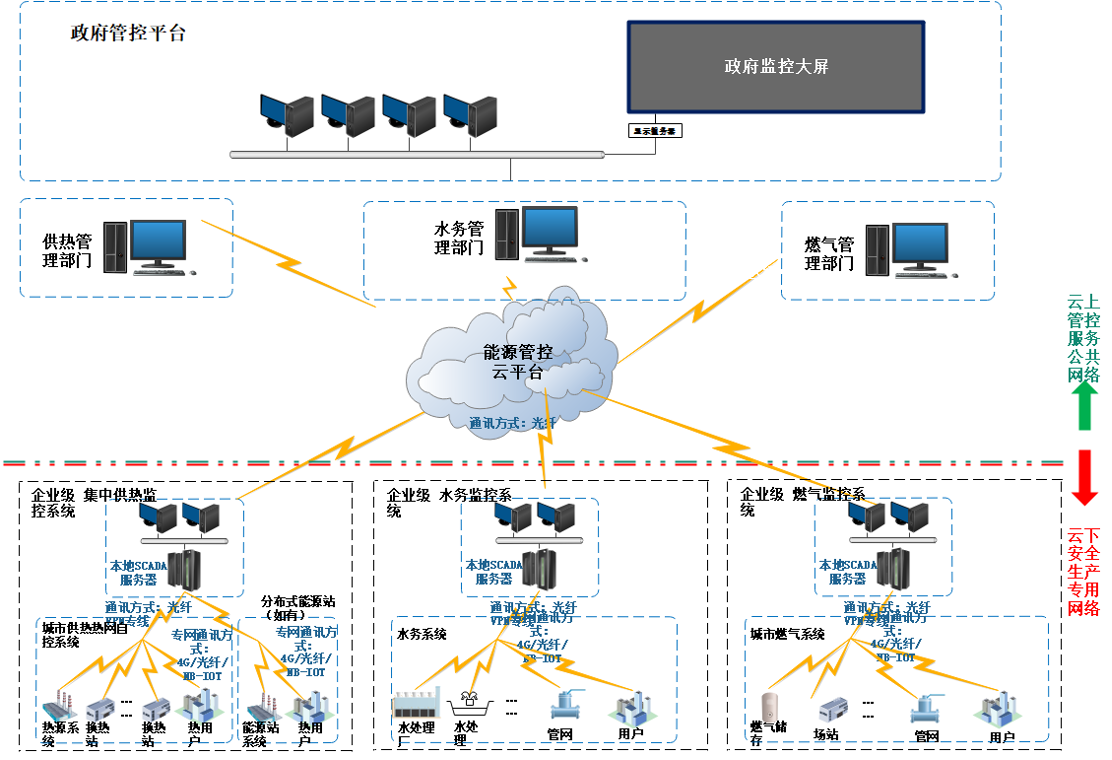
Platform Architecture

1. Establish a City-Level Energy Database: By developing a comprehensive city-level energy database, the platform enables digital monitoring of energy storage, transportation, and consumption processes. The database covers essential service sectors, including urban heating, water supply, and gas, providing the government with strong data support for integrated energy management, regulation, and emergency response.
2. Improve the Energy Consumption Industry Supervision System: Develop a comprehensive regulatory framework for the energy consumption sector that covers both operational activities and service quality. This approach ensures transparency and efficiency throughout all processes while raising service standards and enhancing user satisfaction.
3. Deepen Data Statistics and Analysis for Energy-Consuming Enterprises: By systematically collecting and analyzing key data, such as operational performance, energy consumption metrics, incident rates, and service satisfaction, the platform can comprehensively evaluate the service quality and operational efficiency of energy-consuming enterprises, providing a solid basis for management and technical improvements.
4. Strengthen Urban Energy Emergency Management: Establish a comprehensive energy emergency management system that includes dedicated emergency organizations, detailed contingency plans, and sufficient material reserves, creating a complete response mechanism. This system enhances the city’s capacity to handle unexpected events and ensures the safe and stable supply of urban energy.

Establish a City Energy Management and Consumption Monitoring Platform: The platform provides effective oversight of the operational status, system safety, and service quality of all energy-consuming entities. By centralizing data management and analysis, the platform not only enhances regulatory efficiency but also improves the accuracy of decision-making support, providing a strong foundation for optimizing the city’s energy structure and boosting energy utilization efficiency.
Build a Gas Information Visualization, Monitoring, and Command System: The platform offers comprehensive digital tools, including gas pipeline monitoring, facility safety diagnostics, and inspection management, greatly extending the temporal and spatial reach of gas supervision. It enables timely identification and resolution of potential safety hazards, ensuring the safe and stable supply of urban gas.
Establish a City Water Management Platform: The platform utilizes water quality monitoring, Geographic Information Systems (GIS), and pipeline monitoring technologies to collect and analyze data across the entire water resource lifecycle. It covers all stages, from urban water sources to treatment plants, pumping stations, wastewater treatment facilities, and the intake, supply, and drainage networks. This approach not only promotes efficient use and protection of water resources but also provides a scientific foundation for preventing and responding to water resource crises.
Build an Intelligent Heating Management Service Platform: This platform integrates multiple functions, including basic heating information management, heating operation data management, energy consumption monitoring, service evaluation, and heating safety and emergency command. By enabling detailed management of the entire heating service process, the platform not only improves heating efficiency and service quality but also strengthens emergency response capabilities, ensuring safe and reliable heating throughout the winter.
Beijing Address:
Beiming Software Park, 18 Yongyinqu South Road, Shijingshan District, Beijing
Guangzhou Address:
7-8/F, Beiming Software Building, No. 1 Sicheng Road, Tianhe District, Guangzhou



Copyright ©Beiming Software Co., Ltd. All rights reserved. 粤ICP备11034341号
