


Social assistance, social organization, child welfare, smart elderly care, smart funerals, etc.

The Smart Civil Affairs Solution delivers comprehensive coverage across all core domains—social assistance, social organization, child welfare, smart elderly care, and smart funerals—establishing an integrated service system that is "all-encompassing and vertically thorough." By building a central data intelligence hub, the platform bridges the complete data loop from aggregation and standardized governance to cross-departmental collaboration, multidimensional analytics, and intelligent trend forecasting. This enables efficient pooling, cleansing, and fusion of decentralized data across all departments and levels, truly realizing "single-source data, collaborative sharing, and intelligent decision-making." Building on this foundation, the platform intensively integrates next-generation large AI models to deploy intelligent applications across all scenarios, including public services, business oversight, risk early warning, and decision support, delivering functional modules such as targeted assistance for low-income populations, supply-demand resource matching for child welfare, dynamic monitoring and alerts for elderly individuals living alone or without family, and convenient online funeral service processing. Driven by the dual engines of big data and artificial intelligence, the platform leverages digital technology to empower the high-quality development of civil affairs, establishing a modern digital governance system that is precise, efficient, universally beneficial, and intelligently collaborative. This transforms civil affairs services from fragmented to integrated, from passive response to active perception, and from experience-based to scientific decision-making, truly delivering tangible benefits to every person in need.

1. Leading Architecture and Domestic AI Computing Infrastructure
The solution innovatively adopts the industry's "1+3+1+9+N" holistic architecture, anchored by an integrated government computing power center. It is fully compatible with domestic large models such as DeepSeek and Qwen, and is supported by three knowledge bases, i.e., basic resource library, business thematic library, and policies & regulations library, to comprehensively aggregate all-dimensional civil affairs data. Concurrently, the solution builds a unified AI model middle platform, integrating underlying AI capabilities including natural language processing, multimodal recognition, civil affairs knowledge graphs, and intelligent decision-making. This enables unified management and control of models, agents, knowledge, and business processes, establishing a self-reliant, scalable, and independently controllable AI technology foundation for civil affairs.
2.Comprehensive Coverage Across All Civil Affairs Domains
The solution provides seamless, one-stop integration across 9 key civil affairs functions, namely social assistance, social organization, child welfare, smart elderly care, smart funerals, marriage registration, administrative divisions and toponymy, disability welfare, and charitable organizations. Each business module is equipped with a complete digital subsystem covering the full lifecycle: application acceptance, approval processing, industry oversight, resource matching, and mobile citizen services. This offers unified aggregation and centralized, network-based management of all civil affairs operations, thoroughly eliminating data and operational silos.
3.End-to-End Data Governance and Intelligent Prediction Capabilities
The solution establishes a central civil affairs data hub, enabling comprehensive closed-loop management that spans cross-department data collection, standardized governance, cross-level sharing, multidimensional statistical analysis, and risk trend forecasting. It also integrates external data channels from social security, healthcare, real estate, public security, and other sectors to automatically verify eligibility for social assistance, elderly care, funeral services, and other programs. Leveraging the data hub platform, the system constructs panoramic profiles of individuals and institutions and generates visual operational cloud maps to accurately identify at-risk groups, including low-income populations, elderly living alone, and vulnerable children. This shifts the service model from "citizen-initiated application" to "proactive discovery and preemptive assistance," providing a scientific data foundation for policy formulation and resource allocation.
4.Deep and Comprehensive Deployment of AI Large Models
The solution deploys N categories of tiered AI scenarios, covering both general-purpose large model applications and customized intelligent applications for the civil affairs sector. General AI capabilities include smart consultation, smart form filling, automated document verification, smart data querying, AI-assisted document drafting, and smart oversight of public benefit funds. Industry-specific AI covers smart case assessment, AI-driven autonomous name calibration, AI pre-review of annual reports, AI-generated place names, and automated AI review for filing and annual inspection of elderly care and funeral institutions.
5.Dual Enhancement of Multi-Stakeholder Collaborative Governance and Citizen Convenience Services
On the collaboration front, the solution connects government departments with social resources, including charitable organizations, benevolent enterprises, and volunteers, establishing multi-party coordination channels for assistance, elderly care, and funeral service matching. This creates a "government-led, society-engaged" civil affairs governance framework, complemented by online enforcement, credit tiering, and risk early warning systems to achieve standardized and intelligent sector oversight. On the public service front, the solution provides a mobile palm-service system enabling citizens to submit applications, track progress, and book services online; in addition, grassroots staff can conduct mobile household verification and process work orders anytime, anywhere, truly delivering "fingertip-accessible" civil affairs services and comprehensively elevating public convenience.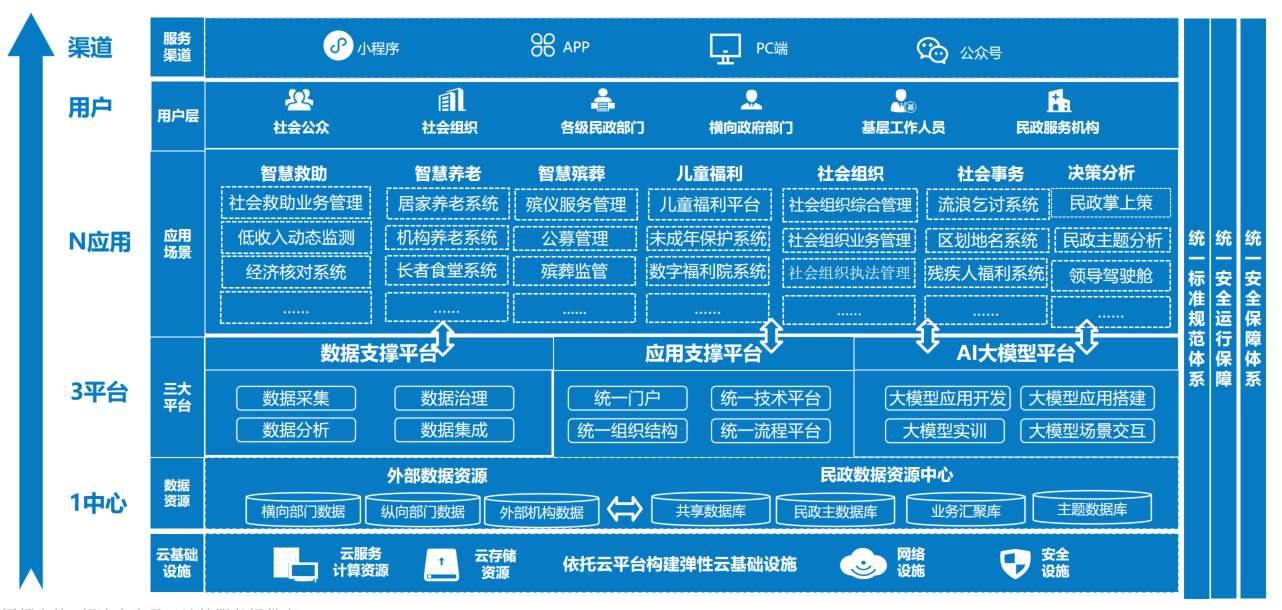
Solution Architecture Diagram

1.Unified Platform and Multi-Level Connectivity: Hosts all core civil affairs operations on a single platform with unified data standards and O&M management, connecting city, district, sub-district, and community levels to reshape the digital governance architecture.
2. Process Simplification and Grassroots Burden Reduction:end-to-end online business loop with parallel approvals, digital archiving, and mobile application and verification, streamlining complex workflows for assistance, subsidies, filing, and annual inspections, effectively easing the burden of repetitive data entry, multiple submissions, and back-and-forth tasks for grassroots staff.
3.AI Empowerment and Data-Driven Decision-Making:underlying capabilities of the AI intelligent platform, the solution provides comprehensive intelligent assistance for government office operations. Each business domain is also equipped with multidimensional statistical analysis, panoramic situation visualization, and industry-profile assessment, clearly presenting the current state of livelihood safeguards, sector operational issues, and changing needs of key populations. This offers a scientific basis for policy formulation and resource allocation, driving the shift of decision-making from experience-based judgment to data-intelligent analysis.
4.Comprehensive Life-Cycle Safeguarding for Special Groups: Establishes dynamic monitoring and end-to-end tracking mechanisms for disadvantaged populations, minors, and the elderly, covering full life-cycle management of child welfare, elderly care resource integration, and capacity assessment, thereby precisely matching support resources and closed-loop risk control.
5.Full Lifecycle Intelligent Dynamic Oversight:Implements whole-lifecycle supervision for social organizations, elderly care institutions, and the funeral sector, covering pre-event filing and review, in-process dynamic control, and post-event traceability and accountability. The solution supports multi-source data monitoring and routine screening for violations, capturing sector risks in real time and effectively resolving regulatory challenges.

Software Development Project for the National Legal Entity Information Resource Database of the Ministry of Civil Affairs
The Low-Income Population Dynamic Monitoring Platform of Shandong Provincial Department of Civil Affairs; Comprehensive Social Organizations Management Platform of Shandong Province; the Civil Affairs AI Large Model and Social Assistance Scenario Integration System of Shandong Provincial Department of Civil Affairs
The Baseline Livelihood Information Verification and Management System of Guangdong Provincial Department of Civil Affairs
Social Organization Legal Entity Information Resource Database System of Inner Mongolia Autonomous Region
The Integrated Relief and Assistance Platform of Shaanxi Province; the Social Organization Integration Platform of Shaanxi Province
Low-Income Population Dynamic Monitoring Information Platform of Gansu Province
Comprehensive Social Assistance Service Platform of Xi'an
"One-Stop Service" System for Civil Affairs of Qingdao
Low-Income Population Dynamic Monitoring Information Platform of Zhangye
Beijing Address:
Beiming Software Park, 18 Yongyinqu South Road, Shijingshan District, Beijing
Guangzhou Address:
7-8/F, Beiming Software Building, No. 1 Sicheng Road, Tianhe District, Guangzhou



Copyright ©Beiming Software Co., Ltd. All rights reserved. 粤ICP备11034341号
