


Digital Government and Smart Cities

To meet government information security requirements, the Large Model Solution for Government Applications is deployed in a private environment. The solution integrates technologies including multimodal data processing, RAG (retrieval augmented generation), KAG (knowledge augmented generation), and AI agents, fully combining large models with government data to develop innovative applications for public administration and public services. The overall technical architecture of the solution is structured into four components: computing infrastructure, knowledge management, application development, and innovative application scenarios. At the foundational level, the computing infrastructure can be deployed on private servers or leverage intelligent computing resources from cloud platforms, supporting flexible deployment of various large model products. Building on this foundation, the knowledge management layer unifies, processes, and refines heterogeneous multi source industry data, including internal government data, social media, the internet, public databases, and business systems, providing rich data sources for large model knowledge retrieval.. The application development layer provides a unified technical framework for building intelligent agents and is equipped with comprehensive development tools and application components. To meet diverse business needs, users can flexibly construct different agents through a visual interface and drag and drop operations. Combined with an agile “develop and debug simultaneously” workflow, this approach significantly lowers the technical barrier to intelligent agent development. At the application layer, in response to the business needs of the government sector, the solution can be used to build a series of innovative application scenarios, including intelligent customer service, smart governance consultation, smart data inquiry, document assistants, policy assistants, intelligent event recognition, intelligent agents, and contract assistants. These applications deliver smarter, more efficient, and more personalized large model services for users.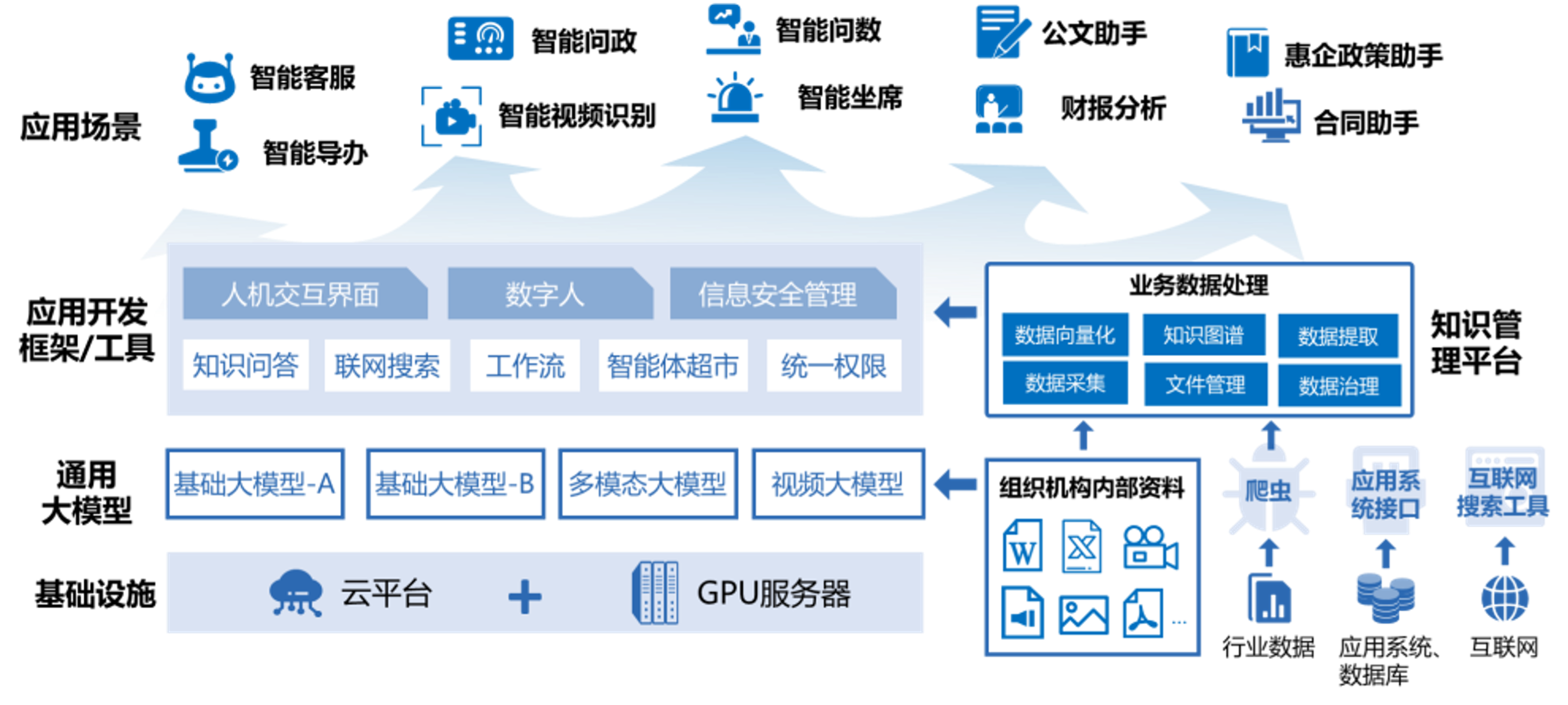
Solution Architecture Design

1. Establishing a New Human–Computer Interaction Mode Based on Natural Language
By enabling interaction through natural language, the system can automatically perform data queries, tool invocation, task execution, content generation, and other complex operations. This approach transforms traditional system workflows based on clicking, selecting, and modeling into simpler and more intelligent question and answer interactions, significantly enhancing the human computer interaction experience and improving overall service efficiency.
2. Optimized RAG Architecture and Intelligent Augmentation to Ensure Content Accuracy
To address logical flaws and hallucination issues that may arise when large models are applied to industry scenarios, the solution adopts an optimized RAG architecture to integrate heterogeneous data from multiple sources. This includes unstructured data such as charts and documents, as well as structured data from business systems. Combined with deep parsing algorithms, intelligent chunking strategies, knowledge augmentation, and reasoning optimization technologies, the solution significantly improves retrieval efficiency and accuracy, ensuring the reliability and precision of generated outputs.
3. Visual Development Mode to Lower Technical Barriers and Enhance AI Application Quality and Efficiency
By leveraging a visual development platform, users can flexibly integrate components such as knowledge bases, Q&A modules, and search tools to rapidly build complex intelligent agent applications. Model and component parameters can be adjusted as needed, improving both the efficiency and quality of application development.
4. Rapid Application Implementation Across Industry Sectors
Building on Beiming Software’s data accumulation and business experience in sectors including government, finance, judicial services, and transportation, the solution can quickly integrate business requirements, industry data, and operational systems with large models. This drives the transformation of existing business processes, enables the development of intelligent and innovative application scenarios, and promotes the rapid implementation of large models across industry sectors.

1. Intelligent Governance
for Government Office Applications: The intelligent governance assistant can rapidly retrieve documents, meeting materials, project information, and other resources based on user queries. By summarizing the retrieved content, it generates relatively accurate responses, reducing the workload associated with locating official documents and compiling information, while improving the utilization of historical records. Document Assistant: The large model based Document Assistant effectively addresses efficiency challenges in government document processing. It provides services such as automatic summary generation, assisted document drafting, and intelligent proofreading, significantly streamlining workflows that previously required hours to review materials and prepare documents, and enabling an intelligent upgrade of government office operations. Intelligent Data Query: The Intelligent Data Query Assistant transforms traditional approaches to data retrieval, statistical analysis, and chart generation. By connecting with government databases and business systems, it deeply integrates large model natural language understanding with automated SQL generation. In response to user queries, the assistant can rapidly retrieve relevant data and generate analytical charts, reducing data analysis tasks to a matter of minutes and enhancing both the work efficiency and decision making capabilities of government personnel.
2. Intelligent Customer Service
for Government Services: Compared with traditional rule based Q&A systems, the large model powered intelligent customer service solution is better able to understand user intent and deliver services through natural language question and answer interactions. It enables consultations on various government service matters, inquiries about service handling processes, casual conversation, and intelligent form filling, meeting the needs of diverse and complex scenarios and significantly enhancing the service experience of the One Stop Online Platform for Government Services.
3. Intelligent Event Reporting
for Urban Governance: During routine inspections, patrol personnel only need to take photos of violations and briefly describe the location and other relevant details. Leveraging the understanding capabilities of large models, the event reporting assistant quickly recognizes image content, analyzes the type of incident, and provides relevant legal references and handling recommendations for patrol personnel to reference and use in rapid event reporting. Compared with the previous process that relied entirely on manual recording, analysis, and judgment, this approach significantly reduces false reporting while improving the efficiency of incident handling.
4. Financial Report Analysis
for Enterprise Management: The financial report analysis assistant connects with dynamic data from the securities market and automatically organizes information on a company’s historical operating data, growth capability, expense ratios, and other relevant indicators. In response to user queries, it can quickly generate concise chart based reports, enabling users to conveniently understand the company’s operating performance. Additionally, the financial report analysis assistant can analyze uploaded corporate financial reports, intelligently extract key data, and generate concise chart summaries. Contract Management: The contract management assistant helps enterprise and institutional users quickly locate critical contract information, including key clauses, purchasers, purchased products, payment terms, and execution periods, significantly improving the efficiency of contract retrieval and review. It can also perform multidimensional statistical analysis on contracts to support managerial decision making.
5. Digital Contingency Planning Assistant
for Emergency Management: Built on large models, the digital contingency planning assistant can quickly analyze key elements of an incident, including its type, severity, and scope of impact, upon receiving disaster related information. At the same time, it automatically retrieves and recommends historical cases most relevant to the current event, providing command personnel with detailed response strategies and best practical solutions.
6.Digital Human Applications:
Leveraging large models, digital modeling, and multimodal interaction technologies, the solution enables the creation of digital humans that closely replicate real human appearances. In addition to casual conversation, business consultation, and service explanation, digital humans can query and present data metrics, generate analytical charts on demand, and execute user instructions such as activating cameras or initiating video conferences, significantly enhancing the overall interaction experience.
7. Intelligent Data Resource Query
for Data Resource Management: Built on large models, the data resource query assistant addresses the data application needs of business departments. Through question and answer interactions, it can query data distributed across multiple departments and business tables in real time, consolidating and presenting the required information to the requesting department. This enhances the efficiency and accuracy of public data resource queries and provides a more convenient experience for service users.

Garze Prefecture, Sichuan Province – DeepSeek Private Deployment Project
Guangdong Province Public Security Department – Smart New Livelihood Project Intelligent Customer Service
Shenzhen, Guangdong Province – Minsheng Police Artificial Intelligence Platform
Changsha, Hunan Province – Government Affairs Integrated Platform Intelligent Applications
Wangcheng District, Changsha, Hunan Province – Government Affairs Artificial Intelligence Platform
Wugang City, Henan Province – Smart City Artificial Intelligence Platform
Beijing Address:
Beiming Software Park, 18 Yongyinqu South Road, Shijingshan District, Beijing
Guangzhou Address:
7-8/F, Beiming Software Building, No. 1 Sicheng Road, Tianhe District, Guangzhou



Copyright ©Beiming Software Co., Ltd. All rights reserved. 粤ICP备11034341号
